One of the areas I really want to concentrate on this year with my kids at home and in my class is developing emotional intelligence.
What is emotional Intelligence?
Emotional Intelligence is the capacity to be aware of, control and express ones emotions. The term was made popular in the mid 90’s by author Daniel Goleman and his book Emotional Intelligence: Why It Matters More Than IQ. In it Goleman suggests that emotional intelligence is more accurate at predicting success later in life than IQ. Children with higher EQ (emotional quotient) are easier to get along with, make better decisions, stay in school longer and are better leaders in the classroom.
Adults with a high emotional intelligence are very self aware. They understand their emotions and because of this don’t let their feelings get the better of them. They have a high sense of self-regulation, the ability to control their emotions and impulses. They are able to delay immediate gains for long term success and are highly motivated. They are also very good team players and have great social skills. Who wouldn’t want that for their child!
Why is it important?
In today’s world where screen time is common and in some cases a large portion of a child’s day, there’s less time spent interacting with other children and adults which is delaying the natural development of ordinary social skills, human interaction, building relationships and most importantly dealing with highly stressful situations.
It also doesn’t help that many people encourage young children to hide what they are feeling “Be a big boy and suck it up” “Big girls don’t cry” “Stop being ridiculous there’s no need to cry”. These phrases do nothing to help a child recognise what they are feeling and how to handle them but instead encourage them to bottle to their feelings.
It is therefore important that we explore some ways to help encourage emotional intelligence in young people.
How can we encourage Emotional Intelligence?
Acknowledge children’s emotions
For a lot of children simply being understood is all they need to reduce the emotional wave. We can help children feel understood by naming their emotions for them.
“I can see that your mad right now because Billy took your toy away.”
“You look frustrated and upset. Would you like some help putting on your jacket.”
Children develop empathy when the see it in action and by experiencing it from others. Naming their emotions shows that you are aware of how they are feeling and can empathise with them. Recently we had my four year old nephew over for the night to stay with my four year old daughter. The two of them are best friends and do everything together. That night while going to sleep my nephew got a little bit upset as he was missing his parents but what I heard next filled me with pride. My daughter turned to him gave him a big hug and said “I understand it can be a little upsetting being away from your mam and dad. I also get sad when I stay away from my mam and dad” My daughter showed great empathy towards her cousin and was able to comfort him just by naming his emotion.
Allow expression
Always allow the child to express and feel the emotion to its fullest. We have become too quick to try and soothe tears with toys and food that children are not able to feel the emotion but bottle it up instead. We should try not to deny their emotions or belittle them. Shouting over a crying toddler just puts your emotion onto an already overloaded child. Holding them, hugging them and responding with empathy allow the child to accept the emotion and understand that these big feelings are ok.
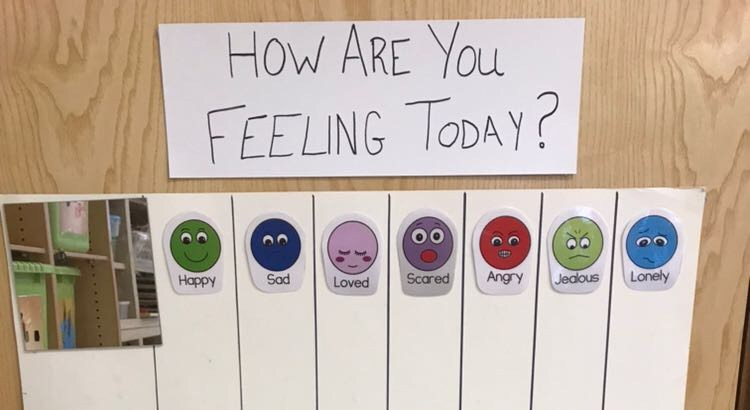
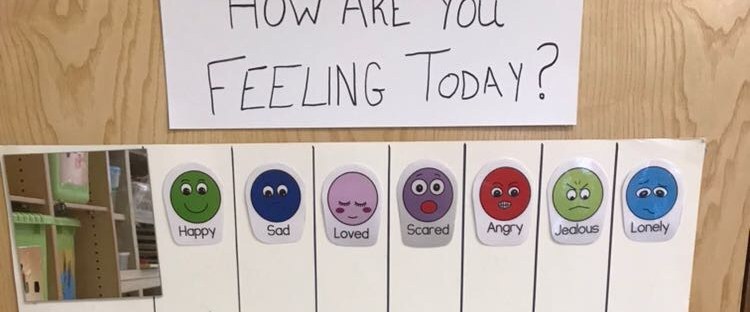
In my daughters school last year the teacher drew up an emotions chart. Each morning and/or break time the children got a chance to go to the emotions board and place their photo under the emotion they were feeling. In this way they were able to express their emotions and the teacher was able to see if anyone needed help. I hope to incorporate this idea into my classroom this year.
Set limits
All emotions are acceptable but not all behaviours are. See outbursts as an oppurtunity to reconnect and teach how to problem solve through the emotion.
Play
Imaginative play is a great way of showing the kids how to deal with their emotions. Simply acting out a situation where mam plays the child in a wave of emotion and demonstrates how she would deal with the emotion. Aistear is a great way of incorporating emotional roleplay in the classroom.
Mindfulness and yoga
Listening to mindfulness CD’s and doing yoga with the children is a great way to regulate and recognise their emotions.
Reading books

There is a range of lovely books out there that discuss emotions. One pack I bought last year for my daughter was the “When Im feeling” series by Trace Moroney. Theres eight books in the series, all beautifully illustrated and they discuss with how the emotion feels, and what they can do to help deal with the feeling. I hope to read these books to my class this year picking a book a month that represents what might be happening that month. For example discussing being scared at halloween time and being loved in February.
I hope these ideas were of some help to you.
 The Tender-Hearted Parent